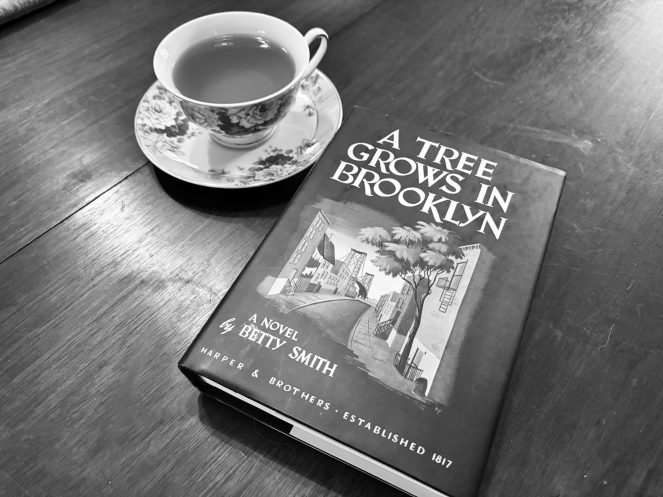
When I embarked on my journey to read the best of the best of 1944’s books, I intentionally did not read any reviews or research any aspects of any of the books beyond their status as best sellers. I did not want to have any preconceived notions or the whisper of another’s opinion in my head about the books, their subject matters, etc. In fact, of the fourteen books that I am planning to read this year, I was familiar with but one title: A Tree Grows in Brooklyn – the first book on my 1944 TBR list.
That being said, the title was all that I was familiar with. When I received my copy in the post, I did read the inside jacket as one does and – I admit – was not particularly enthused with the idea of reading a “coming of age” story of a young girl in Brooklyn at my advanced age of 43. And this – THIS – dear reader, is why you should never EVER judge a book by its cover, title, and frankly dust jacket description. My goodness was I wrong. I had no idea this book was so profound, would resonate so deeply, and had such mind-blowing historical implications.
A massive commercial success, A Tree Grows in Brooklyn was published in 1943 and spent 15 weeks at the top of the New York Times bestseller list, selling over 3 million copies by 1945. A semi-autobiographical tome penned by Betty Smith, the book was her first novel and was largely rejected by the major publishers of the day before finding acceptance at Harper and Brothers in 1942. One of the rare books that has never been out of print, in 2012 the Library of Congress named A Tree Grows in Brooklyn to its list of “Books That Shaped America.”
One of the books printed and distributed as part of the Armed Services Edition program, A Tree Grows in Brooklyn is widely considered to be the most popular of all the books doled out to servicemen during the war. The Armed Services Edition program provided books to GIs that were specifically designed to fit in a uniform pocket and over 1,000 titles and 123 million books ranging from fiction, westerns, history, biographies, poetry, and more found their way to our boys fighting overseas. As with most things during the war, books became a commodity in foxholes and A Tree Grows in Brooklyn was amongst those with the highest value, becoming one of the most desired and frequently traded books. On the surface, this seems illogical. Why would a bunch of battle-tested men have any interest at all in reading about a young girl’s coming of age? Yet, it was a massive hit – so much so that Mrs. Smith received over 10,000 letters from GI’s who read the book. This book was not mere entertainment nor an ordinary distraction and these were not ordinary fan letters. This book helped provide a much needed morale boost; it very well may have helped us win the war. And it most definitely saved lives.
In one of the most now-famous letters received by Mrs. Smith, a United States Marine wrote, “Were you ever so upset emotionally that you had to tell someone about it, to sit down and write it out? Ever since the first time I struggled through knee deep mud carrying a stretcher from which my buddie’s life dripped away in precious blood and I was powerless to help him, I have felt hard and cynical against this world.” While hospitalized, a nurse gave this weary Marine a copy of A Tree Grows in Brooklyn and it changed his life. “I can’t explain the emotional reaction that took place in this dead heart of mine. . . . I only know that it happened,” he continued. “A surge of confidence has swept through me and I feel that maybe a fellow has a fighting chance in this world after all.” He concluded by saying, “I don’t think I would have been able to sleep this night, unless I had bared my heart to the person who caused it to live again.”
Letters like the one above, while extraordinary, were not rare. Another GI wrote to Mrs. Smith: “You helped inspire me during some of my trying days of battle, and battle fatigue depression.” He continued that the book helped him see “the better things in life that I was fighting for.” So strongly did he feel that A Tree Grows in Brooklyn helped him survive the war that he and his wife planned to name their first-born daughter Betty Smith, after the author herself.
And those are just two examples of the many, many more that Mrs. Smith received crediting her and her novel with bringing back a forlorn GI from the brink of utter despair.
If I didn’t love this book before, how could I not absolutely adore it now? I’m almost speechless.
One of the reasons I chose to embark on my 1944 reading challenge was to better understand the mindset of folks during one of the most turbulent times in recent history. At the outset, A Tree Grows in Brooklyn doesn’t seem like it should or would be particularly inspirational. In fact, frankly, it seems kind of … well…depressing. Poverty, addiction, death, constant struggle, and heartache…none of that screams uplifting to me.
Without giving away any spoilers, A Tree Grows in Brooklyn takes place in the time period beginning at the turn of the century and ending at the start of the first world war. The novel follows the story of young Francie Nolan, the deeply impoverished granddaughter of illiterate immigrants, the daughter of a drunkard and a washerwoman. Along the way we learn the stories of her grandparents, her parents, her aunts, and 1900’s America itself. We share in Francie’s joy and her sorrows. We share in the struggles and indignities suffered by a poor girl who is desperate to be the best daughter, sister, and student. We rejoice in her successes and the delight she finds between the pages of a book.
Personally, I saw quite a lot of myself in young Francie, her determination, and her resilience. And I can easily see now why this book was as popular as it became.
Far from a depressing read, A Tree Grows in Brooklyn proves that the American Dream is alive and well. Where there is hard work and never-say-die spirit, there is a path to a better life. Where there is faith in oneself, there is always hope for the future.
My only regret is that it took me 43 years to read this book. What a literary triumph. A Tree Grows in Brooklyn has firmly secured a permanent place on my list of favorites. If you have not read it, you are missing out on something truly special. Man, woman, young, old. None of that matters. This is a book for all. This is a book for the ages. Out of 5 stars, I give this one a 10.
I’ve decided that I’ll be ending these posts with my favorite passage from the book itself. Choosing just one from A Tree Grows in Brooklyn was nearly impossible, but after learning what I have about the power this book has had and the lives that it has changed, I thought it fitting to end with Francie’s prayer:
“Dear God, let me be something every minute of every hour of my life. Let me be gay; let me be sad. Let me be cold; let me be warm. Let me be hungry … have too much to eat. Let me be ragged or well-dressed. Let me be sincere— be deceitful. Let me be truthful; let me be a liar. Let me be honorable and let me sin. Only let me be something every blessed minute. And when I sleep, let me dream all the time so that not one little piece of living is ever lost.”
Next up: Sholem Asch’s The Apostle. In the meantime, happy reading.